Monday, 15 August 2022

Sonora to Yosemite.

The Gold Rush is such a big thing out here. I suppose California was 'founded' on it and they have plaques to its discovery and to remember the names of men who did.

An aside in all these places and tours is that they really just skim over the history and lives of Native Americans. Which is a real shame. I can't decide if they're disinterested, a bit ashamed or if they just spent so long not talking about it, it doesn't occur to them to do so. Sad really.

Anyway, we went to visit a town called Columbia, which is one of the oldest in the area (c1850). Its not inhabited now, but is made up of a number of houses and shops, some of which are set up as they would have been, and some of which you can buy things in. The staff are dressed as people were back in the day. Mostly, anyway, many wear trainers and you can see leggings peeping out under dresses.

We timed our arrival for a tour. Obvs. 
Columbia (the female form of Columbus) had many towns named after her. Originally they thought about calling it American Camp, but that seemed too impermanent. To this day there exist local towns called French Camp and Chinese Camp. 
Welcome to the California Store. An upmarket place for upmarket people.. You can tell that by the slab of marble outside. Marble was mined locally. 
Chicken Licken. Hens were highly prized and there is a record of a man paying $3 for an egg - equivalent to $100 today. 
Where the posh people shopped. Things were paid for in pinches of gold. Shop keepers often sought out employees with large hands, as it was the seller who took the pinch. 
Where the poor people shopped. Scurvy was a real problem. Miners lived off dried consumables, like legumes, mushrooms and hard tack - a delicious creation of baked flour, water and salt, which lasted forever, could only be eaten by adding in moisture and often contained wevills and other insects. Mmm
What happened if you resorted to thieving. 

The outhouse - used by rich and poor alike. Complete with its own thunderbox. 
A wagon of the type many travelled in day to day. Though you did need money to have one and many prospectors just walked. 
A wagon of the type many travelled in when they were dead. The hearse wagon. This is an original one. 
A home. 
The old bath. Once a week, whether you liked it or not. One lot of water, largest to smallest, in size order. 
Sleep tight, don't let the bed bugs bite.. Mattresses were suspended on frames using rope. The tighter it was, the better sleep you had. Horsehair mattresses were the posh version. 

Bowling was a recreation. 
As was gambling. Apparently miners would gamble on anything. 
Then we tried our luck panning for gold. 
Apparently, there are 'gold nuggets and semi precious gems' in these troughs. 
Rich! Rich beyond our wildest dreams, I tell you. 

Then we drove to Yosemite. It was an absolute scorcher of a day. 
Sat nav in the car was sitting at 99 degrees F, but it did go up to 106. With that and the winding roads I had to stop, NN2 feared vomiting. It was like the Horseshoe Pass for 18 miles. 
Eventually, we arrived. 
Wow. It's so majestic. Really amazing. NN2 wanted to see a place which is famous because people climb it. I was looking for signs but didn't see any.  I saw this:
So I stopped to take a photo. Turns out it was what we were looking for. 
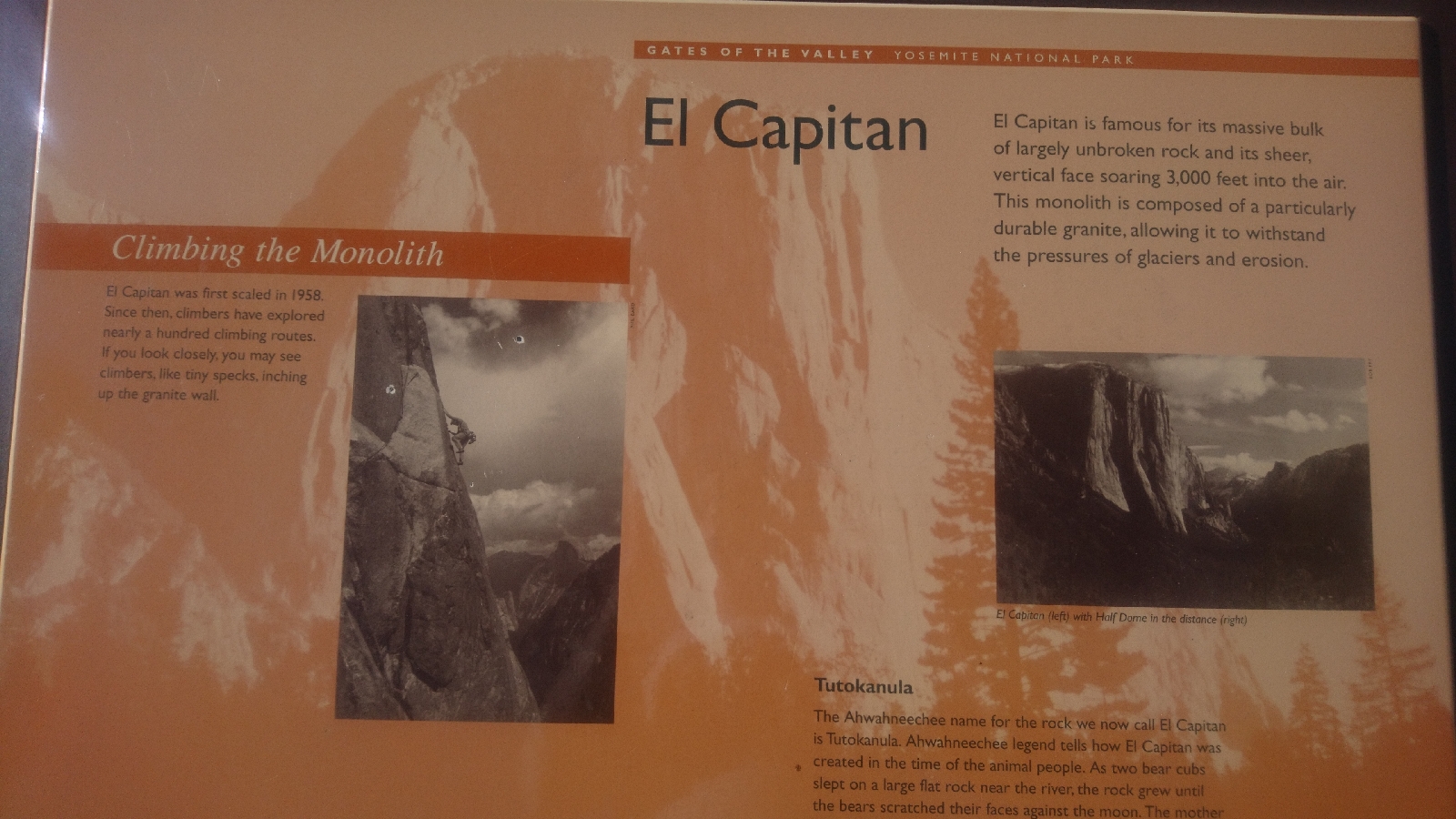
Meet El Capitan. 
After taking some pics while The Captain posed for us, NN2 went scrambling across the rocks while I had a paddle. 
Yosemite is full (we are told) of bears, wolves and bison. 
I saw a lizard. 
Headed home through a beautiful sunset. Traumatically running over a pre run over (and dead) cat on the way. I felt sick. NN2's reaction? 'Just to finish it off?' 


Sunday, 14 August 2022

San Francisco to Sonora.

I'd hired a car, so today we went back to the airport to pick it up.
it's the BART train's birthday this year. Yay! 

We collected the car. 
Which has Minnesota plates.
The first car they have us was a Californian plated one but that has no GPS and I need GPS!

We drove north to a place Called Mill Valley, to see some Redwoods.

The Mill Valley Library is just behind those trees.

There is a woman in those roots.
Then we drove to Lake Chabot. It was hot and I really fancied a swim. 
Wasn't even allowed to bloody wade! 

The place was beautiful, though and we saw some eagles circling, which was amazing. 
Then we went to an enormous outlet village, to do some more shopping. 

After that we headed for Sonora. It was a two hour drive through some really varied countryside and farm lands towards Yosemite. 

Eventually, we landed here! 
in this beauty..

Friday, 12 August 2022

San Francisco - Day 3

Today we headed to Alcatraz. A bit of a walk to Pier 33, on our pre booked trip. You have to pre book. There are literally 100 people arriving every 25-30 mins throughout the day by ferry, each of which is booked up. Soooo many people heading to 'The Rock'. Scene of Clint Eastwood's famous escape film. You know the one. 


So we took a very packed boat, all wearing masks because it's going to a federal place. Where there is absolutely no food, no eating or drinking (except water) allowed. 

To make it to Alcatraz, the prison, you had to have met a couple of criteria:

  1. Committed a federal crime. 

  2. Been a difficult inmate in another prison and so moved. 

I feel as if I could have made it. 


Prior to being a prison it was an army base. Constructed to protect San Francisco and the bay area. Later army prisoners and conscientious objectors were (often cruelly) housed there. If you refused to fight in 1918, you could be shipped there, kept in a 'coffin cell' (clue on size in the name) for 14 days, fed on bread and water with no toilet and no bed. Oh. And you wouldn't be let out for the entire fortnight. Some inmates were still there after the war had ended. 


The army prisoners were different. They were allowed to do jobs like babysit the children of the guards who also lived on the island. As you do. 

Native American peoples were also shipped there if they refused to get off their lands. Or give up their children on demand. It's a place with a cheery history. 


Once the army left the government took it on as a full prison. They built a group of cells 3 'streets' wide and three layers tall. With a separate area for 'treatment' of psychopathic/ very difficult individuals. There was a recreational area, a dining room where prisoners were very well fed actually, a library, a large kitchen and a visitation suite. There were gardens and places for the staff to live. 


The streets were called Broadway, Madison Avenue and a place I understood to be called Seedy Street. This was until I saw the sign and realised that, due to the block coding, it was actually C-D Street. 


When we arrived Ranger Benny gave us an orientation walk, then Ranger Wendy took us for a short tour towards the audio tour pick up place. I lost NN2 for about 20 mins when I went to the loo and he was still on the tour. Walked around asking staff if they had seen 'a lad in red converse'. When found his  response to this was, 'what d'you do that for?'


Anyway, the tour was good. Informative and interesting. In the film Clint hatches a plan to escape on a raft made of raincoats which were stitched together. THIS ACTUALLY HAPPENED. The idea came from a magazine the inmates read in the library called something like, Mechanics Monthly, in which readers were shown step by step instructions on how to make a raft out of raincoats. 


One of the escapees was a barber, who saved the hair he chopped off his customers to make three hairy heads to hide in the beds and fool the night guards. They escaped by tunnelling out of the wall with drills (spoons were mentioned, but not sure where they came into it), shinning up an inside vent and down an outside drain. Then they paddled two miles on their raincoat raft. Their clothes were found in a nearby island, so authorities came to the conclusion that they had drowned. The actual outcome is a mystery.. 


Finally, (which could have had a bigger part in the exhibition) was the impact Alcatraz had on the rights of Native Americans. There was a law in the last century which said that if the government were not using federal lands they could be returned to the Native peoples. However, the government always broke these laws. So, to demonstrate about this, a group of Native Americans and sympathisers moved to the island and lived there for 19 months. They were well supported (Jane Fonda sent them generators) and it was well publicised. The effects of their stay was an awakening of the rights of Native peoples across the US. I was told today. 

Following the audio tour, we wandered down and took the ferry back. On the way we stopped and had some dim sum. Which NN2 thought was OK. 


After a brief trip back to the hotel, we decided to catch a cable car. I was very excited about this! The cars have been running for 150 years. They go up and down the steepest streets using wooden blocks as breaks. These are levered down towards the floor and you know they are working when you smell burning wood (only 3 brake accidents in 150 years!).  They cars are also beautifully made out of wood. When travelling, if you want to stand on the external running board you can. I did. It was very exhilarating. 

We're both thrilled. 


Tomorrow we are moving on, so needed to organise a bit. We packed our dirty laundry and I brought it down to one of the launderettes. I quite like a launderette. I treated myself to a cold drink and I'm sat here writing today's blog. 


Root beer is..unusual and has a taste I'd like to describe as medicinal. 

NN2 has popped off to the shops. He came back with two t-shirts, a hoodie and some new sweets.